


When the invention is the connection: patenting the smart drug-delivery device
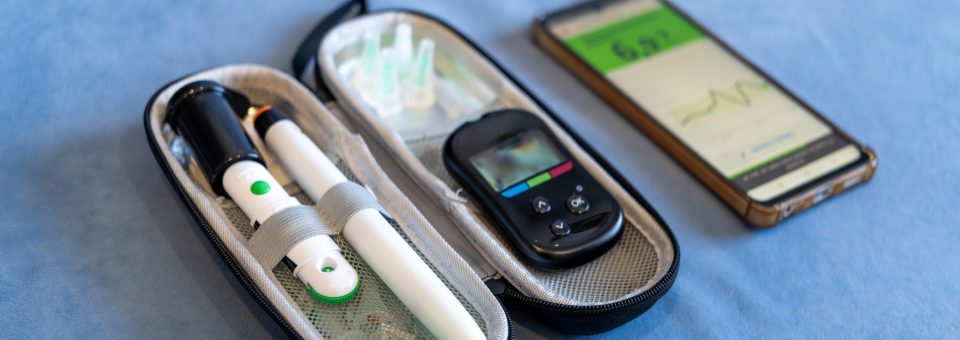
Connected drug-delivery is not a new field. Smart insulin pens have been cleared for use in the US since 2016, and pens with dose memory functions go back further still. That maturity matters to anyone filing today. The mechanical layer of drive mechanisms, dose-setting arrangements, cartridge interfaces and needle shields has been refined over decades with the result that patentable improvements in the mechanical layer are progressively harder to make.
In some senses, the commercially valuable innovation has moved up a layer. It now sits in the sensing and control layer, encompassing what the device senses, what it does with those signals, and how it coordinates as part of a larger digital ecosystem such as with a phone or remote service. This is also where patentability in Europe can be hardest, because two obstacles apply to that layer and they pull in opposite directions.
Where the inventive work sits
In a simplified smart insulin pen, a sensor detects a selected or dispensed dose, a controller determines that an injection has occurred, and a wireless interface transmits an event record to a companion device such as a smartphone or tablet. The e.g. phone timestamps the event, adds data such as blood glucose readings, and forwards the result to a remote service that maintains the treatment history.
In many cases, dose sensors, controllers and wireless transceivers are individually well-established components, and a patent claim merely reciting them in combination is unlikely to survive. The inventive aspect can sit instead in what they do together, such as reliably identifying a dose event, synchronising dose and glucose data, handling intermittent connectivity, performing secure pairing, avoiding duplicate records, enabling power-efficient transmission, or implementing a feedback loop that turns a sensed signal into a control signal.
Many of those inventive aspects are responses to a constraint created by splitting the product across several devices, such as a radio link that drops, a battery that must last months, a phone that is not always to hand, or two records that must be reconciled without knowing which arrived first. Those constraints are often inherently technical problems, and a patent claim that solves a technical problem is far easier to defend in Europe than a claim framed simply around the information the system produces.
Establishing technical character
The EPO’s Guidelines for Examination deal expressly with distributed computer-implemented inventions at F‑IV, 3.9.3. They confirm that such an invention can be realised across a client device and a server, and that a claim set may cover the individual entities, the overall system and the corresponding methods. That maps neatly onto a pen, a phone and a cloud platform. Where the distribution of steps matters, claims should clearly identify which entity performs which step, so that the clarity requirement of Article 84 EPC is met.
Technical character can be the harder hurdle. Under the EPO’s COMVIK approach, set out in T 641/00 (Two identities/COMVIK), only features contributing to the technical character of the invention can support inventive step, however novel a non-technical feature may be in itself. G 1/19 (Pedestrian simulation) emphasises the point that matters most here: that it is not enough that software runs on hardware, because the effect relied upon must go beyond the ordinary interactions between the two.
A consequence when drafting patent claims in the field of connected drug-delivery is that we should look to describe the physical consequence of data processing, not simply the information it yields.
Claiming a feature of “Selecting a recommended insulin dose from patient history” invites an objection from the EPO that the contribution is merely clinical or administrative rather than technical, and thus inventive step may be questioned. A feature combination such as “Determining a dose-delivery event from a sensor signal, buffering the event locally, detecting a failed acknowledgement from a paired device and retransmitting the buffered event according to a defined protocol” is far easier to defend in Europe as a technical implementation.
This approach matters increasingly for medical data. In T 1741/22 (New medical data/ROCHE), the Board held that the mere generation of further data from measurement data already collected from the human body is not a technical effect. The Board drew a distinction between obtaining measurements from physical reality, which is technical, and subsequent analysis of those measurements, which is not necessarily technical merely because the source data originated from a technical measurement. The decision does not mean that processing medical data is inherently non-technical. Rather, the claimed processing must be shown to contribute to the solution of a technical problem.
Article 53(c) pulls the other way
Article 53(c) EPC excludes methods of treatment by surgery or therapy from patentability in Europe. It does not apply to products. Device and system claims therefore fall outside this exclusion, with a claim to a drug-delivery device not objectionable merely because the device is later used to administer medicament to a patient.
The Article 53(c) EPC exclusion generally arises from the inclusion of a therapeutic treatment step in a claimed method. A method that merely acquires data, determines a dosage and outputs a dosage recommendation will often not fall within the exclusion, because the therapeutic decision and any subsequent administration remain outside the scope of the claim. The assessment is highly sensitive to claim wording, though, and small drafting differences can be determinative. The exclusion risk increases, however, where the claim requires administration of the calculated dose to the patient, or is drafted such that therapeutic administration forms an integral part of the claimed method.
Here lies a difficulty, and it is why this technology can be harder to draft for Europe than first appears. There are two obstacles that pull against each other.
Drafting a method claim to include a drug-delivery step often makes technical character, and therefore inventive step, easier to argue. The claim ends in the physical control of an actuator, which is unambiguously technical. However, an explicit drug-delivery step is precisely where Article 53(c) causes problems.
Pull back to computing and displaying a recommendation, and the risk of the claim being excluded under Article 53(c) falls away. However, the claim now outputs information for a human to act upon, which may cause the EPO to question technical effect and inventive step.
In practice, the most robust claim strategy often lies between these extremes. Ideally, we are looking to claim a device that acts on its own measurement in a way that changes its own physical state, such as locking out a duplicate dose, flagging an incomplete injection, or adjusting an interlock. We want technical effect at the mechanism, without a therapeutic step in the claim.
One invention, four claim targets
A single independent claim rarely covers a distributed system effectively, with the reason being commercial rather than technical. Where the pen manufacturer, the phone app provider and the cloud operator are three different entities, a system claim can leave the patentee without a single infringer to sue or license. It is therefore important to ask who, in practice, will supply or perform each element of the system and to claim the elements accordingly. Where the overall architecture encompasses an injection pen or pen module, a phone and server, we would therefore expect to consider the following claim targets:
- The device. The pen or smart-sensing module attachable to a pen, and particularly its sensing and control architecture. This is valuable against a competitor that makes or otherwise deals in the pen or module, whatever its app and cloud service do. Care should be taken to avoid importing features of a remote system into this claim unnecessarily.
- The companion device. The phone or other companion device, where a technical contribution sits, such as authenticating a newly paired pen, reconciling stored events against cloud records, or rejecting duplicates. Competitors’ pen hardware tends to be similar, so the phone is increasingly a commercially important part.
- The server. Processing event records received from the companion device, maintaining states, reconciling asynchronous data, or controlling another device.
- The system. The combination of all three. This is usually the most faithful description of the invention, but it can be more difficult to enforce in infringement proceedings where functionality is being divided between different third parties, perhaps across different jurisdictions.
Method claims should also be added for each entity, and computer program claims in jurisdictions, such as Europe, that permit them. Computer program claims are particularly important for companion device- and server-based inventions, where the hardware is generic and likely also pre-existing.
The bigger shift
Mechanical innovation has not stopped mattering in the field of drug-delivery. What has changed is that the unit of innovation is now larger than the physical product. While the thing sold may be a physical pen, pump or inhaler, the invention is increasingly found in a distributed control system and the relationship between its parts.
For connected drug-delivery technologies, successful European patenting increasingly depends on identifying three things: the technical problem being solved, where in the distributed architecture that solution is implemented, and which commercial actor performs the relevant steps. The connection, rather than the device itself, is often where the invention now resides.
The future of freight has already arrived
Thinking outside the box: IP protection for toys and games
Share
