


The future of freight has already arrived
As Londoners grow accustomed to the sight of robotaxis testing on public roads, attention is naturally focused on when the necessary regulatory requirements will be met to enable autonomous passenger services to begin in the UK. Yet a short distance up the English coast, the future is already here to see.
Over several months, autonomous vehicles have started to become a familiar sight on London’s streets. They are visibly equipped with perimeter and 360-degree LiDAR systems, as well as long-range and perimeter radar sensors, and are currently deployed in non-commercial mapping trials in the capital. Although the vehicles are currently required to operate with a safety driver behind the wheel, they offer a glimpse of what the journey home after a night out will look like in the not-too-distant future.
While autonomous taxi services are already established in some other countries, notably in parts of the USA and China, operators are still readying themselves for commercial services to commence in the UK. Offering trial services to paying customers, even with a safety driver at the wheel, requires companies to meet the “triple-lock” requirement of the UK licencing framework, in which the operator, driver and vehicle are all licensed by the same authority. A subsequent move to driverless services will require an Automated Passenger Service (APS) approval from the Driver and Vehicle Standards Agency (DVSA) and consent from Transport for London (TfL).
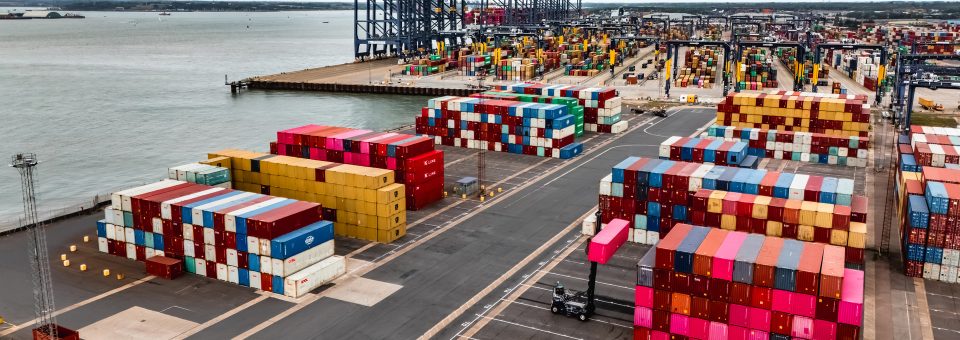
While that red tape is being navigated, it may be surprising to learn that autonomous vehicles have already been working productively in the UK for several years. At the Port of Felixstowe, sophisticated self-driving trucks transport containers around one of Britain’s busiest ports.
The first autonomous trucks were deployed at the port in 2023, and are supplied by Chinese AI logistics company Westwell. The port has recently announced [1] an order for a third batch of the trucks, taking the total fleet to 100 vehicles.
The environment in which the trucks operate is by its nature hazardous, making the use of self-driving vehicles an attractive proposition for safety reasons. However, this is complicated by the need for mixed-mode operation, in which autonomous trucks work alongside other vehicles operated by human drivers. Each truck is equipped with numerous sensors for mapping its surroundings, including 128-line LiDAR, radar, and 360-degree monocular and stereo camera vision. The risk of collisions is also reduced by providing the trucks with interactive light signals and audiovisual alerts to communicate their driving intentions clearly to the drivers of nearby human-operated vehicles.
Navigation is controlled using an on-board GPS system to track the position of the truck against a digital map. Westwell’s Extreme Precise Position (EPP) system can achieve vehicle position accuracy of 2 cm and a steering angle accuracy of 0.5 degrees [2]. Fast and secure communication between autonomous trucks, control systems and terminal infrastructure is provided by one of the largest private 5G networks in the UK.
The trucks are also fully electric and emission-free. Combined with the port’s use of only renewable electricity since April 2023, the Westwell fleet is helping it towards its Net Zero ambitions. One of the features you are unlikely to see on a London robotaxi, however, is the port’s automated battery swapping station, at which the trucks can exchange depleted batteries for fully charged ones in a matter of minutes. A second such station is planned to complement the recently announced expansion of the fleet.
Neil Kennett, Editor of Carsofthefuture.co.uk, recently visited the site and was impressed [3]. He commented to Venner Shipley: “While London’s robotaxi trials grab the headlines, the Westwell autonomous trucks at Port of Felixstowe quietly go about their work. Moving shipping containers from A to B in complex mixed-traffic environments, they provide compelling real-world evidence of AV safety and efficiency benefits. The fact they’re electric too, in almost constant use thanks to the automated battery swapping station, is a noteworthy cherry on top.”
With international shipping accounting for more than 80% of all goods moved around the world every year [4], seaports represent an important frontline in the battle to cut pollution and reduce the carbon footprint of the entire supply chain. Finding novel solutions in this area will therefore bring environmental benefits, while shaping the future of industrial vehicle deployment.
Innovation is at the heart of Westwell’s business strategy, with around 70% of its employees working on R&D [5]. Accordingly, the company’s intellectual property is recognised as one of its key assets. One of seven winners of the World Intellectual Property Office (WIPO) Global Awards in 2023, Westwell has a growing portfolio of IP registrations, from patents and utility models to trade marks, registered designs and copyrights.
The company has made use of WIPO’s international patent application system, and has filed patent applications spanning a wide range of innovations across the construction and operation of its autonomous trucks. Notable examples include:
- a method for aligning a container truck with a crane, using three-dimensional radar imaging data;
- a vehicle battery swap system, detailing how a track-mounted battery swap robot moves batteries from a containerised charging station directly onto an autonomous truck, to replace a depleted battery; and
- a battery pack locking system for providing secure dual-locking of the vehicle’s battery in position, while still allowing for automated quick release of the battery pack at the battery swap station.
International design registrations also protect the striking appearance of the driverless Q-Truck.
As the fleet of self-driving trucks continues to expand in Felixstowe, these vehicles are becoming an increasingly significant part of the port’s complex mixed-traffic landscape. This trend appears set to continue, with the autonomous truck market expected to more than double in size to over US$100 billion by 2034 [6].
As technology enthusiasts eagerly await the launch of commercial robotaxi services among the traffic on London’s busy streets, operations at the Port of Felixstowe already provide a vision of the future today.
Ref:
- Port of Felixstowe expands autonomous truck fleet to 100 units
- Westwell and Hutchison Ports Port of Felixstowe Have Signed A Contract to Introduce over 100 Q-Truck
- The UK’s most advanced autonomous vehicle deployment: Westwell at Port of Felixstowe
- Shipping data: UNCTAD releases new seaborne trade statistics
- Westwell's Smart Port Technology For a Sustainable Supply Chain
- AUTONOMOUS TRUCK MARKET SIZE AND FUTURE OUTLOOK
Share
